



Voice data collection in UAE helps AI systems learn how people pronounce the same words in different ways. A speech model may recognize a clearly spoken command but struggle when the speaker uses an unfamiliar accent, pronunciation or speaking pace. A well-planned collection process gives developers audio that reflects these differences more realistically.
For voice-enabled technology, variety is important because people do not follow identical speech patterns. Some speakers may shorten words, place emphasis on different syllables or combine languages while speaking. Capturing these differences gives an AI model more examples from which to learn.
Why Does Accent Diversity Matter in AI Training?
Speech models identify patterns within recorded audio and use them to predict what a speaker has said. If the training material represents only a limited group of voices, the system may perform well with familiar speech but become less reliable when it encounters different pronunciation patterns. Wider representation can therefore make testing more meaningful.
English may be spoken with different regional influences, while Arabic speech can vary across dialects. Some speakers may also move between Arabic and English during the same interaction. These characteristics are worth considering when defining the speech requirements for an AI application.
Which accent variations should be represented?
Accent coverage should be planned according to the intended use of the model. Instead of collecting a large amount of similar audio, teams can identify the speech characteristics most likely to affect recognition.
- Regional pronunciation: Capture relevant differences in vowel sounds, consonants and word stress.
- Speaking pace: Include both steady speech and naturally faster delivery.
- Code-switching: Record suitable examples where speakers move between Arabic and English.
- Pronunciation differences: Include alternative ways of saying common words, names and commands.
This approach helps us generate a more intentional database. It also becomes simpler to determine whether certain forms of language have been sufficiently captured or need further recordings.
How Can Voice Data Collection in UAE Capture Different Accents?
A structured recording plan can make accent coverage easier to manage. A voice data collection company can organize participant recruitment, scripts, recording requirements and annotation instructions around the technical needs of an AI project. Establishing these details before recording begins reduces unnecessary or unsuitable samples.
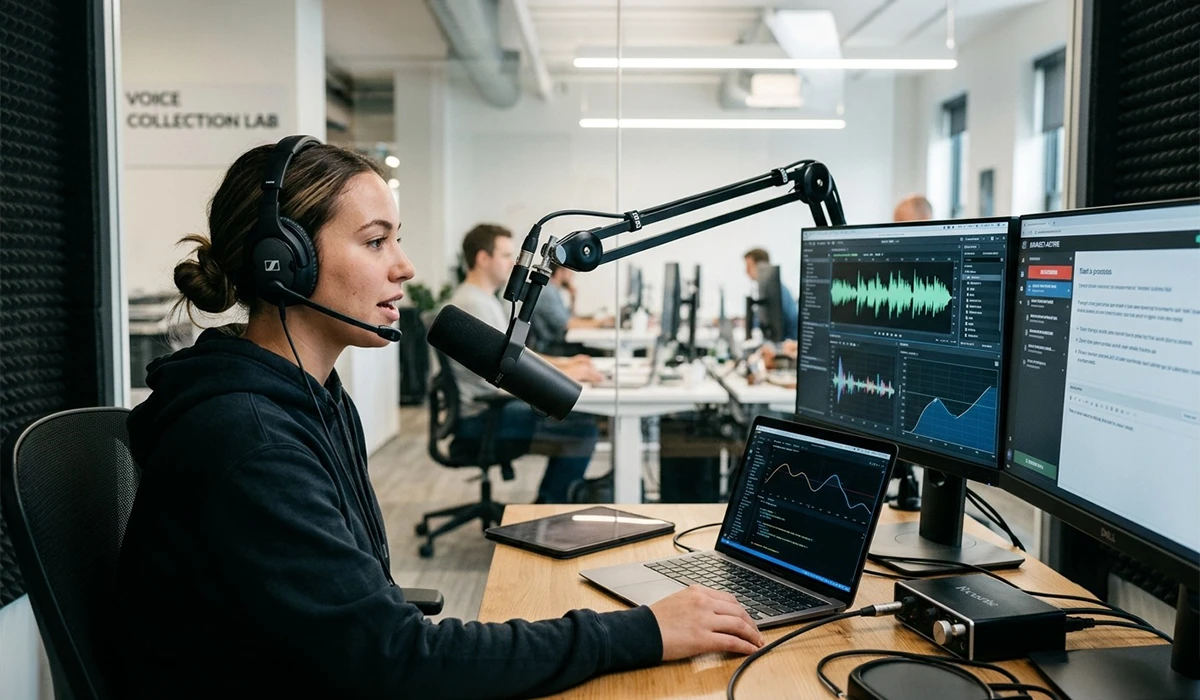
The recording environment also affects the usefulness of the final material. Controlled sessions can provide consistent audio, while carefully designed natural prompts can introduce variations in pace, pronunciation and delivery. Using both approaches can give developers a broader view of how people speak.
Which collection methods can be combined?
The most suitable method depends on the type of speech the AI system needs to recognize.
- Scripted reading: Participants read selected words and sentences to target specific pronunciation patterns.
- Prompt responses: Speakers answer questions or respond to instructions using their own wording.
- Command recordings: Participants provide practical instructions such as setting reminders or requesting information.
- Natural speech: Suitable recordings can capture pauses, repetitions and changes in delivery.
These methods serve different purposes rather than simply repeating the same type of data collection. The script method provides control over individual words and phrases, while the open-ended method introduces greater variation in how people use those words in natural conversation.
What Types of Audio Samples Help AI Recognize Accents?

Different sample lengths can reveal different recognition challenges. Short phrases make it easier to study individual sounds, while complete sentences provide surrounding context. Longer recordings can also show how pronunciation changes when speakers move naturally from one word to another, making AI voice data collection more representative of everyday speech.
Automatic speech recognition systems need enough variation to connect different pronunciations with the correct words. A dataset containing only carefully pronounced sentences may not represent the conditions under which a voice system is actually used. Sample selection should therefore reflect the tasks and environments expected after deployment.
Which recordings can add useful variation?
A balanced collection can include several types of speech:
- Short words and phrases: Useful for examining specific sounds and pronunciation differences.
- Complete sentences: Provide linguistic context for recognition.
- Numbers and dates: Useful for applications handling appointments, addresses and schedules.
- Names and place names: Help test words that may be pronounced differently by different speakers.
- Spoken commands: Reflect the short instructions commonly used with voice-enabled systems.
Each sample provides information for a unique training and evaluation requirement. The use of a combination of all the samples can help the developers understand how the AI performs in dealing with sound and speech.
How Can Multilingual Voice Data Collection Improve Model Performance?
Multilingual systems need to distinguish between changes in language and changes in pronunciation. A speaker might use an English technical term within an Arabic sentence or switch languages when giving a particular instruction. Training material that reflects these patterns can help developers evaluate how the model handles real multilingual speech.
Multilingual voice data collection should therefore be organized with clear language and speech labels. This allows development teams to identify which recordings belong to particular language groups and compare performance across them. It also prevents different types of speech from being mixed together without sufficient documentation.
How should Arabic and English recordings be prepared?
Language requirements should be defined before participants begin making any recordings. The language requirements may comprise single languages or mixed languages.
- Arabic voice data collection: Include the dialects and pronunciation variations relevant to the intended application.
- English recordings: Represent the accent differences expected among the target speakers.
- Mixed-language recordings: Include natural examples of switching between languages.
- Transcribed recordings: Apply consistent rules for spelling, dialect terms and borrowed words.
Clear annotation instructions are particularly important when multiple languages appear in the same dataset. Reviewers should know how to label language changes and how to handle words that do not have a straightforward written equivalent.
What Quality Checks Make Accent Data More Reliable?
Audio quality may have a tremendous impact on the usability of the training set. Even if the speaker pronounces every word correctly, clipping or a very low recording volume can make the sample unusable. Quality checks should therefore assess both the recording itself and the information attached to it.
An AI training dataset workflow should combine automated checks with human review. Software can identify technical problems such as silent files or unsupported formats, while reviewers can assess transcription accuracy and the suitability of each recording. This combination is more effective than relying on either method alone.
What should reviewers check?
A practical quality process can include:
- Recording quality: Check volume, clarity, distortion and unwanted background noise.
- Transcript accuracy: Compare the written text with the actual recording.
- Speaker information: Confirm that required speaker details and relevant labels are complete.
- Annotation consistency: Check that language and accent categories follow the agreed guidelines.
- Consent records: Verify that the required permissions have been properly documented.
Consistent monitoring during data collection helps prevent unsuitable files from being included in the final dataset. It will normally be more efficient than discovering and solving issues at the end of the whole project.
How Should Businesses Choose a Voice Data Collection Partner?
The right provider should be selected based on how well its processes align with the specific requirements of the AI project. The amount of recordings alone does not mean that the resulting data set will contain the required accent, language, or speakers. Companies need to review the entire process from start to finish.
When comparing voice data collection companies in UAE, businesses should ask how speakers are recruited, how recordings are reviewed and how transcripts are validated. It is also useful to understand how the provider manages different accents, languages and recording conditions. These details can reveal whether the collection approach is suitable for the intended model.
What should be included in the project brief?
A detailed brief can prevent misunderstandings during collection.
- Define the AI application: State whether the data is intended for speech recognition, transcription, voice commands or another purpose.
- Specify speech requirements: List the languages, accents, dialects and speech types required.
- Set technical standards: Confirm recording formats, duration, audio quality and transcription requirements.
- Establish review procedures: Explain how unsuitable recordings will be identified and replaced.
- Set delivery requirements: Define the required file structure, metadata and documentation.
A clear brief also helps businesses compare providers on practical criteria rather than simply looking at collection capacity. It gives both sides a shared understanding of what a successful dataset should contain.
Conclusion
Voice data collection in UAE is most effective when accent coverage is planned around the actual requirements of an AI system. Different speakers, pronunciation patterns, languages and speech styles can reveal challenges that a narrow dataset may overlook. Careful recording, accurate transcription and structured quality checks can help create more useful training material.
When developing speech-based technologies, businesses must consider not only the quantity of recordings but also the quality of the recording process. A well-structured dataset based on well-defined needs allows developers to test the accuracy of recognition and see where more training data is required.
Anaemo Insights, a market research company in UAE, supports structured voice data collection, audio preparation and quality checks for AI training projects.
Post a comment
Related Posts
August 5, 2026
Voice Data Collection Company: Building AI-Ready Speech Datasets for Enterprise Applications
The voice data collection company services have become increasingly important as organisations invest in artificial…

July 17, 2026
How Voice Data Collection Companies in UAE Support ASR and Voice AI Training
Voice Data Collection Companies in UAE are essential contributors to modern speech AI development. They…